
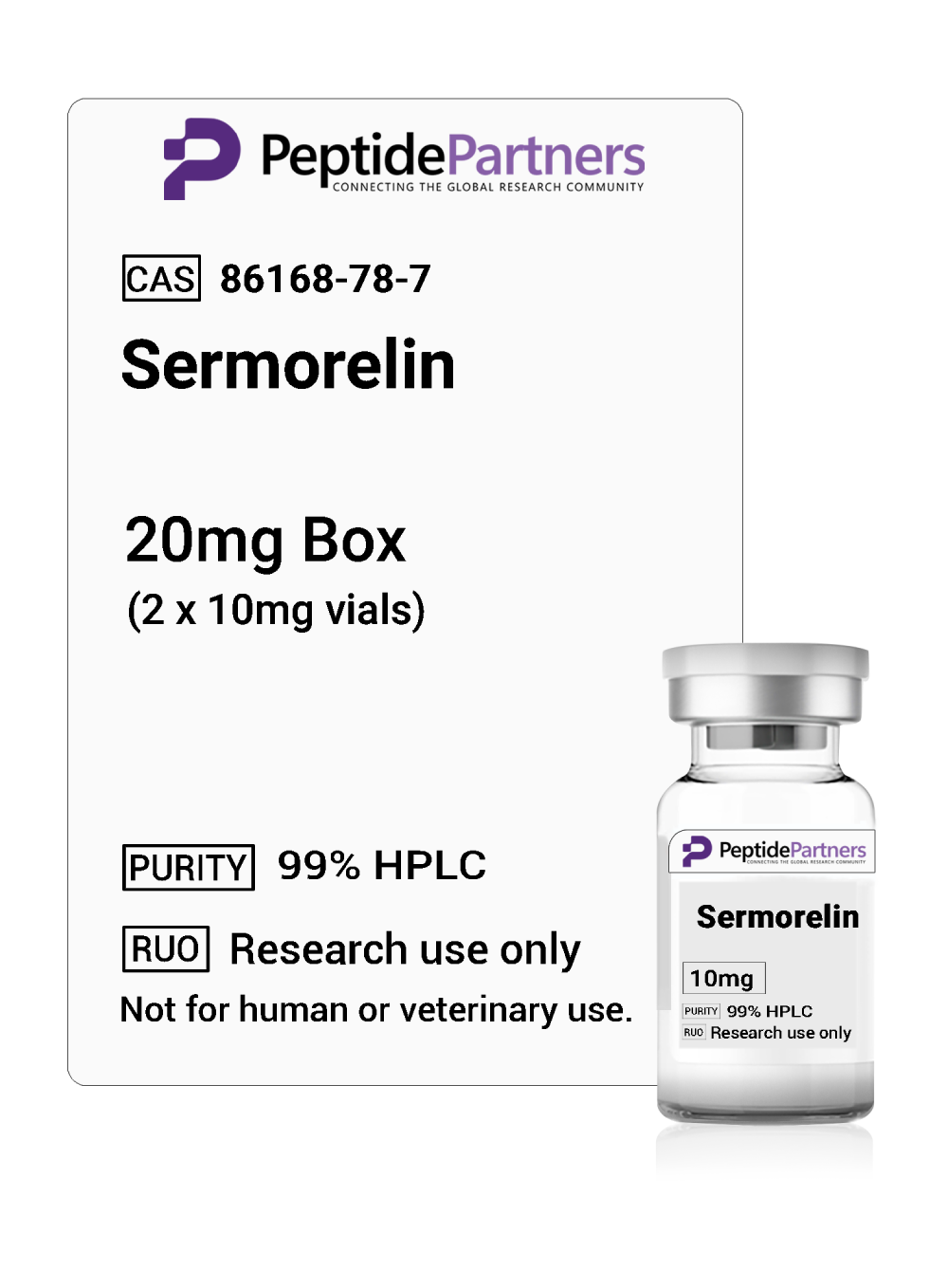

Sermorelin (10mg vials)
Price range: $98.00 through $797.00
• Purity: 99.94% (multi-vial, independently tested)
• Format: 10mg vials (3 mL capacity)
• Box Options: 20mg, 50mg, 100mg, 200mg combinations
• Testing Status: Endotoxin, heavy metals & purity screening PASSED
• Cost Efficiency: $3.98 – $4.90 per milligram
Sermorelin is a synthetic growth hormone-releasing hormone (GHRH) analog investigated for its role in GH secretion modulation, cell proliferation effects, and metabolic stability in preclinical research. This research-grade material supports in-vitro experimentation focused on GHRH receptor pharmacology, glioma cell biology, metabolite characterization, and analytical detection methodology development.
- Independent certificate details, manufacturer IDs, and batch IDs should be reviewed before purchase when available.
- Order cancellations for full refunds are available before shipment; shipped orders cannot be cancelled or refunded.
- For damaged or incorrect goods, photograph the outer packaging, inner packaging, and product labels, then email support within 48 hours of carrier delivery.
Buy Sermorelin – Peptide Partners
Product Overview & Specifications
Sermorelin is a synthetic growth hormone-releasing hormone (GHRH) analog investigated for its role in GH secretion modulation, cell proliferation effects, and metabolic stability in preclinical research. Peptide Partners supplies this research-grade material for in-vitro testing, laboratory experimentation, receptor pharmacology, structural biology, and analytical method development.
Published studies have examined sermorelin using glioma cell lines (U87, LN229), in vitro urine metabolism assays, human plasma incubation studies, LC-HRMS/MS detection methods, immunoaffinity purification techniques, and anti-doping analytical protocols. Research areas include GHRH receptor binding, cell cycle modulation, metabolite identification, DPP-IV enzymatic degradation, and analytical detection methodology.
The product name supplied for this listing is “Sermorelin.” Researchers should verify the exact identity, sequence, formulation, and batch-specific certificate of analysis before beginning any experiment. Findings from published sermorelin studies should not be assumed to apply to every commercial batch or formulation.
Product Specifications
| Specification | Details |
|---|---|
| Product name | Sermorelin |
| Compound type | Synthetic growth hormone-releasing hormone (GHRH) analog |
| Primary molecular targets | GHRH receptors, dipeptidyl peptidase-IV (DPP-IV) enzyme |
| Primary research areas | GH secretion modulation, cell proliferation studies, metabolite characterization, analytical detection methods, anti-doping analysis, and glioma cell biology |
| Product format | 10 mg vials |
| Vial size | 10 mg |
| Vial capacity | 3 mL |
| Available box combinations | 20 mg, 50 mg, 100 mg, and 200 mg |
| Multi-vial purity | 99.94% |
| Independent testing | Yes |
| Endotoxin screening | Passed |
| Heavy-metals screening | Passed |
| Purity screening | Passed |
| Manufacturer ID | VI32 |
| Batch ID | SER202601 |
| Cost per milligram | $3.98–$4.90 |
The stated 99.94% purity is based on multi-vial testing. Researchers should review the batch-specific certificate of analysis before beginning any experiment.
Primary Research Studies & Findings
A Potentially Effective Drug for Patients with Recurrent Glioma: Sermorelin
Authors: Chang Y, Huang R, Zhai Y, Huang L, Feng Y, Wang D, Chai R, Zhang W, and Hu H
Publication: Frontiers in Oncology, 2021
PMCID: PMC8033379
Reference: View publication
The study investigated the effect of sermorelin on glioma cell lines U87 and LN229. The results showed that sermorelin inhibited the proliferation of these cells in a dose-dependent manner. The study suggests that sermorelin may inhibit tumor cell proliferation by blocking the cell cycle.
Gene ontology (GO) and Kyoto encyclopedia of genes and genomes (KEGG) analyses found that the Drug Resistance Score (DRS) of sermorelin was negatively correlated with cell proliferation and immune function. The researchers employed computational biology approaches alongside cell culture experiments to characterize sermorelin’s effects on glioma cell behavior.
The findings indicate that sermorelin exhibits anti-proliferative activity in glioma cell lines through cell cycle interference mechanisms. The study provides a foundation for further investigation of sermorelin’s effects on cancer cell biology in laboratory research settings.
Plain-English Research Summary
This research explored whether the peptide Sermorelin could be a potential treatment for a type of brain tumor called glioma. The scientists tested Sermorelin on cancer cells in a lab dish and found that it could stop the cancer cells from growing. The study suggests that Sermorelin might work by interfering with the cancer cells’ ability to divide and multiply. It also seems to boost the immune system’s ability to fight the cancer. This is an early-stage study, but it suggests that Sermorelin could be a promising new drug for patients with recurrent glioma.
Advances in the Detection of Growth Hormone Releasing Hormone Synthetic Analogs
Authors: Memdouh S, Gavrilović I, Ng K, Cowan D, and Abbate V
Publication: Drug Testing and Analysis (Wiley), 2022
DOI: 10.1002/dta.3183
Reference: View publication
This study investigates the in vitro metabolism of four growth hormone-releasing hormone (GHRH) synthetic analogs, including sermorelin, in fortified urine for anti-doping purposes. The researchers identified nineteen major in vitro metabolites of these GHRH analogs. For sermorelin, several degradation products were identified, which will aid in the development of more effective detection methods for its misuse in sports.
The research employed advanced analytical chemistry techniques to characterize metabolite profiles of GHRH analogs in biological matrices. The metabolite identification data supports the development of sensitive, specific detection methods for anti-doping laboratories and forensic applications.
The findings provide a comprehensive metabolite profile for sermorelin and related GHRH analogs, enabling more accurate detection in biological samples. This research is critical for maintaining the integrity of competitive sports and ensuring fair play through reliable analytical testing protocols.
Plain-English Research Summary
Scientists in this study were looking for a way to detect if athletes are illegally using substances like Sermorelin to enhance their performance. They developed a method to find these substances in urine. In the lab, they mixed Sermorelin with urine and observed how it breaks down. They identified several smaller pieces, or ‘metabolites’. Knowing what these metabolites look like is crucial for creating a reliable drug test, because the test can then look for these specific markers.
Qualitative Identification of Growth Hormone-Releasing Hormones in Human Plasma by Means of Immunoaffinity Purification and LC-HRMS/MS
Authors: Knoop A, Thomas A, Fichant E, Delahaut P, Schänzer W, and Thevis M
Publication: Drug Testing and Analysis, 2016
PMCID: PMC4830873
Reference: View publication
This study aimed to develop a method for detecting various growth hormone-releasing hormones (GHRHs), including Sermorelin, in human plasma for anti-doping purposes. In an in-vitro experiment, Sermorelin was incubated in human plasma. The researchers observed that Sermorelin was completely degraded after 4 hours. They identified a metabolite, GRF(3-29), which results from the cleavage of the N-terminal Tyr-Ala-residue by the enzyme dipeptidyl peptidase-IV (DPP-IV).
This finding is important for developing effective anti-doping tests, as it’s often the metabolites of a substance, rather than the substance itself, that are detected in biological samples. The study utilized immunoaffinity purification coupled with liquid chromatography-high resolution tandem mass spectrometry (LC-HRMS/MS) for sensitive and specific detection.
The research demonstrates that sermorelin undergoes rapid enzymatic degradation in plasma through DPP-IV-mediated cleavage, producing characteristic metabolites that serve as detection markers. The analytical methodology developed in this study provides a robust framework for GHRH analog detection in forensic and anti-doping laboratories.
Plain-English Research Summary
Scientists in this study were looking for a way to detect if athletes are illegally using substances like Sermorelin to enhance their performance. They developed a method to find these substances in blood. In the lab, they mixed Sermorelin with human blood plasma and observed how it breaks down. They found that Sermorelin is broken down into a smaller piece, a ‘metabolite’. Knowing what this metabolite looks like is crucial for creating a reliable drug test, because the test can then look for this specific marker.
Standard Research Disclaimer
Research Use Only. Not for use in diagnostic tests.
This product is solely intended for research purposes as a chemical compound. It is designated exclusively for in-vitro testing and laboratory experimentation. All information provided about this product is educational and should be evaluated by appropriately qualified research personnel.
By law, bodily introduction of this product into humans or animals is strictly prohibited. This compound must not be used, administered, or represented as a drug, food, dietary supplement, growth hormone treatment, performance-enhancing compound, anti-aging product, cancer treatment, diagnostic material, or medical treatment. It is not intended to diagnose, treat, cure, or prevent any disease. It should be handled only by licensed and qualified professionals in an appropriately equipped laboratory and in accordance with applicable laws, institutional procedures, and relevant safety requirements.
| Choose pack |
2 vials × 10mg (20mg total) ,5 vials × 10mg (50mg total) ,10 vials × 10mg (100mg total) ,20 vials × 10mg (200mg total) |
|---|
- All of our manufacturing partners produce peptides using the Lyophilization (Freeze Drying) process, ensuring products maintain stability for shipping and storage for 12+ months.
- In lyophilized form, they are shelf-stable for many weeks. However, for long-term storage, it is recommended to store them in the freezer.
- We often hear concerns about the standard "discard after 28 days of first use" disclaimer. Don't worry, this has nothing to do with studies regarding the efficacy of specific peptides. 28 days is the FDA requirement for producers of multi-use vials to prove their bacteriostatic maintains efficacy. This minimum requirement becomes the de facto standard.
- In our experience, if you use proper sterile procedures and refrigerated storage, you can continue sampling from the same reconstituted vial for 3+ months.
Certificate records
No published certificate records are available for this product.
Search Certificate LedgerRelated products

5-Amino-1MQ (10mg vials)
Price range: $56.00 through $195.00
Cagrilintide (10mg vials)
Price range: $335.00 through $1,050.00
GLP-1 Semaglutide (10mg vials)
Price range: $285.00 through $976.00
GLP-2 Tirzepatide (40mg vials)
Price range: $260.00 through $3,090.00
GLP-3 Retatrutide (24mg vials)
Price range: $230.00 through $1,512.00
Ipamorelin (10mg vials)
Price range: $82.00 through $577.00
